
Sleep Training: Helping Your Baby Learn to Fall Asleep Independently
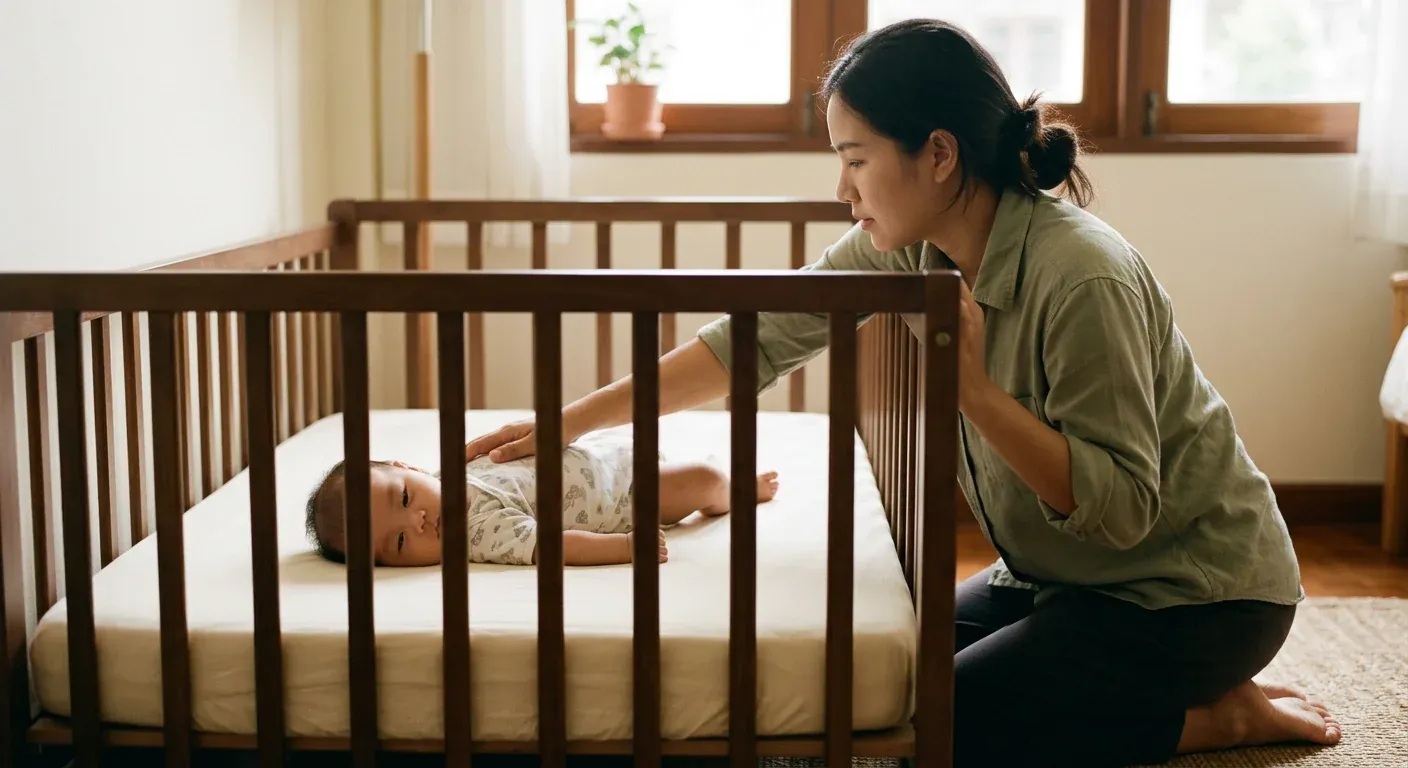
Sleep training is not "letting your baby cry." — It's teaching your baby to fall back asleep without help — a skill, not a punishment.
By around 4–6 months, many babies wake frequently at night — not from hunger, but because they haven't yet learned to resettle on their own. When a sleep cycle ends, they call for the same conditions that were present when they first fell asleep.
Sleep training is a family of techniques designed to help babies learn to fall asleep, and fall back asleep, independently. There is no single "best" method, and it is not something every family needs to do. This article draws on AAP [1] [4], NHS [2], and WHO [3] guidance to help you make an evidence-based decision — not one driven by social pressure.
What sleep training is — and isn't
Sleep training means teaching your baby to fall asleep without requiring external help (nursing, rocking, or being held) every time. It addresses sleep associations — the conditions a baby links with falling asleep. If those associations require a caregiver, the baby will signal for them every time a sleep cycle ends.
What sleep training is not:
- A punishment or a way to ignore your baby's needs
- A rigid schedule imposed regardless of the baby's cues
- Something every family must do
- The same as leaving a baby to cry indefinitely without a plan
When is a baby ready — and when is it too early?
AAP guidance [1] is explicit: babies under 4 months do not yet have regular sleep cycles, and all cries should be responded to promptly. Do not attempt sleep training before 4 months.
Signs a baby may be ready (typically 4–6 months and older):
- Good weight gain, and the pediatrician confirms nighttime feeds every 2–3 hours are no longer medically necessary
- Baby is already stringing together some longer stretches at night
- No current illness, teething, or developmental growth spurt
WHO guidelines [3] note that infants aged 4–11 months should get 12–16 hours of total sleep per day, including naps. Adequate sleep supports healthy development.
When it's too soon:
- Under 4 months of age
- Baby is sick, teething, or feverish
- A major household change has just occurred (move, new sibling)
- Baby is in the middle of a temporary sleep regression (common at 4 months, 8–10 months, and 18 months)
Safe sleep is non-negotiable — regardless of method
Before beginning any sleep training, the ABCs of safe sleep must be in place. AAP [1] is unambiguous on this:
- A (Alone) — Baby sleeps in their own sleep space, not in the adult bed
- B (Back) — Always on the back until baby can roll independently
- C (Crib) — Firm mattress, fitted sheet only — no pillows, bumpers, blankets, or stuffed animals
No sleep training method modifies any of these rules. For the full safe-sleep guide, see our article on safe sleep.
A note on co-sleeping: room-sharing (same room, separate sleep surface) is fully consistent with AAP recommendations. Bed-sharing (same adult mattress) remains a SIDS risk factor, particularly under 4 months, regardless of sleep training approach.
The methods — no single "best"
These are the main approaches that have been studied. All work when applied consistently. They differ in how much parental presence is involved during the learning period.
1. Graduated extinction ("Ferber method")
Graduated extinction means placing the baby in the crib drowsy-but-awake and waiting before responding — starting with short intervals (e.g., 3 minutes) and gradually increasing them over successive nights. Parents do return to offer brief, calm reassurance (without picking up), then leave again. This is not unlimited crying — it is time-limited, structured, and phased.
2. Extinction ("cry it out" — full)
Extinction means placing the baby drowsy-but-awake, leaving the room, and not returning until the morning wake time (barring genuine emergencies). It tends to work faster but requires significant parental resolve. The term "cry it out" is widely misused — formally, it refers to this method, not to graduated extinction.
3. Chair method ("camping out" / gradual retreat)
A parent sits in the room — visible but not interacting — while the baby falls asleep. Each night, the chair moves closer to the door, until the parent is outside. This takes longer but suits families who are uncomfortable leaving the room entirely.
4. Bedtime fading
Bedtime fading means temporarily setting bedtime at the moment the baby is genuinely sleepy (often later than desired), so less time is spent fighting sleep. Once the baby falls asleep easily at that time, the bedtime is shifted earlier by 15 minutes each few days. This approach involves no crying at all and follows the baby's own rhythms.
5. Pick-up / put-down
Place the baby down drowsy-but-awake. If crying becomes distressed, pick up and soothe until calm, then put down again. Repeat. This method is demanding for parents and can sometimes stimulate rather than soothe. It suits families who cannot tolerate any crying but are prepared for a slower process.
The common thread in every method: Place the baby down drowsy-but-awake. That is the core skill being learned — falling asleep from a drowsy but conscious state. Waiting until the baby is fully asleep before placing them down removes the learning opportunity.
What the evidence does — and doesn't — say
AAP [1] supports helping babies learn to fall asleep independently from 4 months, but does not endorse any single method as superior.
What the evidence shows:
- Graduated extinction and extinction are effective at reducing nighttime waking
- No evidence of long-term harm to parent-child attachment when these methods are applied appropriately to age-appropriate infants
- Babies who sleep better tend to have improved mood and behavior; parents who sleep better provide better care
What the evidence doesn't settle:
- Most studies follow outcomes for weeks to months, not years — long-term data are limited
- Results depend heavily on parental consistency; studies of inconsistently applied methods show weaker effects
What to avoid:
- Starting and stopping mid-method: inconsistency prolongs the process and confuses the baby
- Starting during illness, teething, or developmental leaps
The cultural conversation — Thai families and sleep
Many Thai families co-sleep, nurse to sleep, or rock to sleep — and these are legitimate, loving parenting choices. A baby who is thriving, safe, and reaching developmental milestones with these approaches is doing well.
Sleep training is one tool, not a moral imperative. If your current approach gives both you and your baby adequate rest, there is no reason to change.
The honest question is: is everyone in the household sleeping enough? If yes, carry on. If persistent sleep deprivation is affecting the family's wellbeing, sleep training offers an evidence-based path forward — but it is a choice, not an obligation.
A practical starting point for families who want to try
Build a consistent bedtime routine first
NHS guidance [2] recommends a predictable pre-sleep sequence every night. A simple version:
- Bath
- Change into sleep clothes / fresh nappy
- Last feed (at the start of the routine, not at the end)
- A short quiet book, or a lullaby
- Place baby in the crib drowsy-but-awake
A consistent bedtime routine is the foundation of every method. It signals to the baby that sleep is coming and reduces the overall time to sleep onset.
Gradually shift sleep associations
If your baby falls asleep nursing, start moving the feed earlier in the routine, then gently rouse the baby before placing them in the crib. Repeat consistently over 3–7 nights — most babies adjust within a week.
Allow two weeks before evaluating
Changing methods every few nights prevents the baby from learning anything. Commit to a consistent approach for at least two weeks before deciding it isn't working.
When to pause — or call the pediatrician
Stop and reassess if:
- Baby becomes ill, feverish, or is actively teething
- A sleep regression begins (common at 4 months, 8–10 months, 18 months) — pause and resume when the regression passes
- After two weeks, waking has increased rather than decreased
- A parent feels they cannot continue without real distress to their own mental health — parental wellbeing matters as much as the baby's
Talk to a pediatrician [4] if:
- Baby is 6+ months and still waking more than 3–4 times per night without improvement after consistent effort
- Sleep apnea, reflux, or another health issue may be contributing
- You're unsure whether your approach is age-appropriate
Summary
Sleep training can improve sleep for both baby and parents — but only if it fits the family. It is not required, it is not the only valid approach, and it should never start before 4 months.
What every method agrees on:
- Not before 4 months — young infants need responsive care
- Drowsy-but-awake — the skill is falling asleep from a conscious state
- A consistent bedtime routine — the foundation every method builds on
- Safe sleep is constant — the ABCs apply regardless of training method
- Give it two weeks before switching methods
- No method is universally best — choose one you can apply consistently, with goodwill toward your child
แหล่งอ้างอิง
- AAP HealthyChildren — Getting Your Baby to Sleep
- NHS — Helping Your Baby to Sleep
- WHO — Guidelines on physical activity, sedentary behaviour and sleep for children under 5 years
- AAP HealthyChildren — Healthy Sleep Habits: How Many Hours Does Your Child Need?
- กรมอนามัย กระทรวงสาธารณสุข — สุขภาพแม่และเด็ก
- Samitivej Hospital — Pediatric Health Information